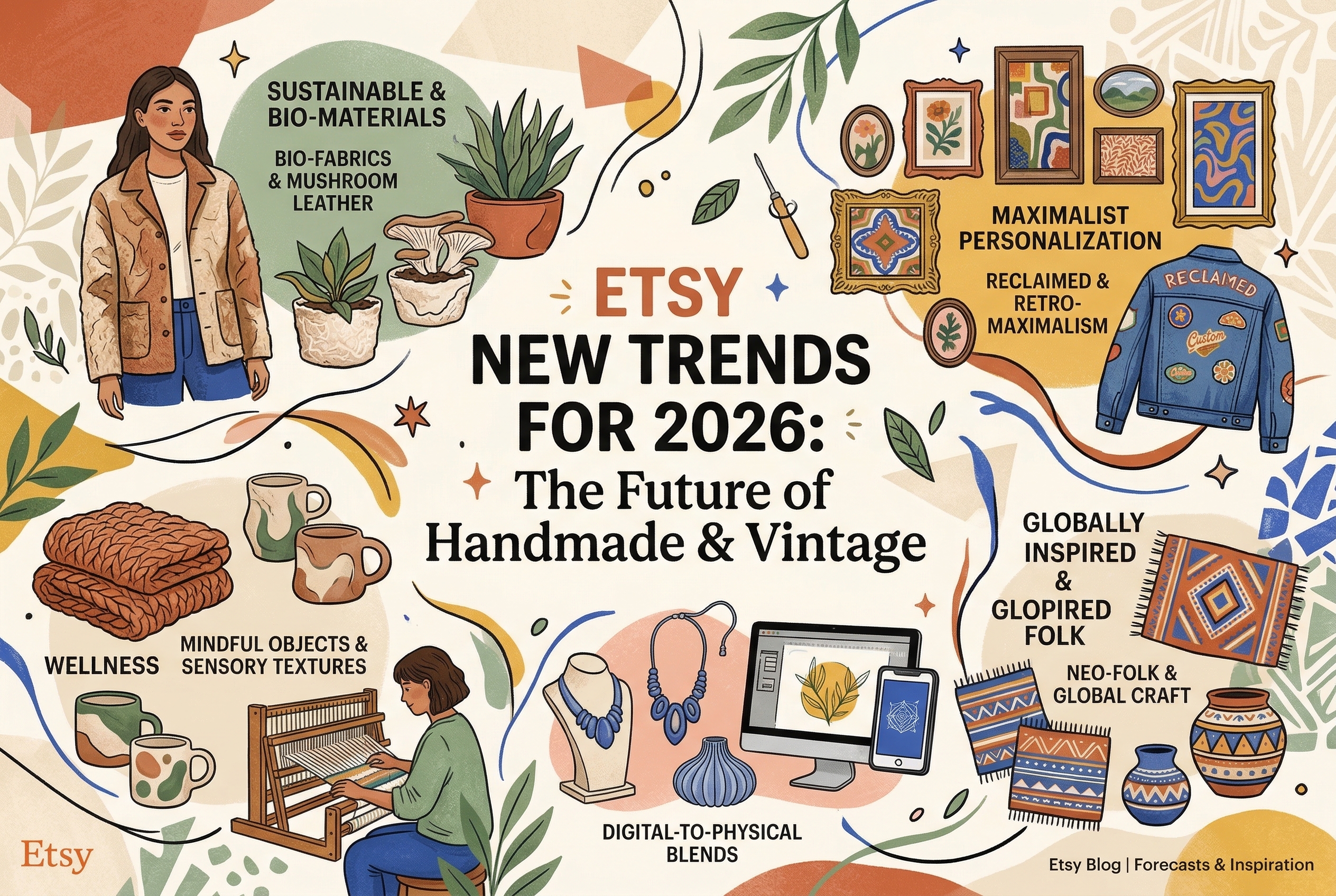
If you look closely at Etsy in 2026, you’re not just looking at a marketplace. You’re looking at a live dashboard of what people want to buy, what they want to express, and how they want to feel. Etsy has always been the home of handmade, vintage, and niche digital products, but the way those categories are evolving this year says a lot about where online business is heading.
Below we’ll walk through the key Etsy trends shaping 2026, and then look ahead at where this ecosystem is likely going next.
1. AI‑Assisted Creativity Goes Mainstream (But Authenticity Still Wins)
One of the biggest shifts on Etsy in 2026 is the quiet normalization of AI‑assisted creative work.
You see it everywhere:
- Printable wall art generated or refined with AI tools
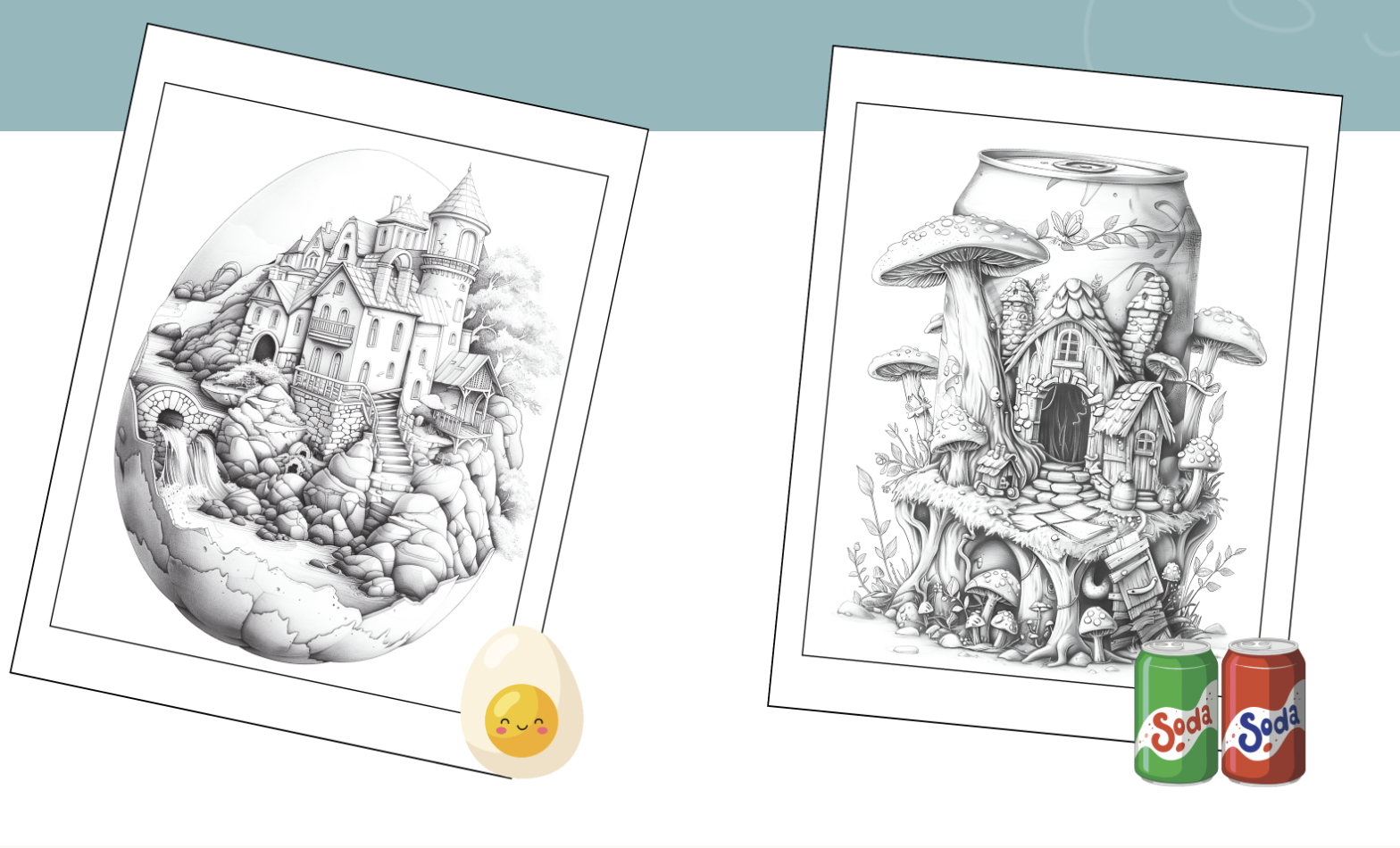
- Prompt‑engineered coloring books and activity books
- AI‑augmented branding kits, logos, and social media templates
- Pattern design, surface design, and mockups that start from AI outputs and get polished manually
Most buyers don’t care how the creator got to the final design. They care whether the product feels:
- on‑trend,
- cohesive,
- and genuinely useful or beautiful.
What’s actually working in 2026 is hybrid creativity: sellers who use AI to speed up ideation and rough drafts, but still curate, edit, and apply a clear visual style.
You can see the difference when you scroll search results:
- Cheap, unedited AI art dumps are easy to spot and don’t convert well.
- Collections where the seller has a consistent color palette, typography, and brand identity—regardless of whether AI helped—rise to the top.
What this means for the future:
Etsy is not going to become a wall of random AI noise. The platform rewards:
- strong branding,
- repeatable visual language,
- and clear value promises.
AI will keep getting better, but the shops that win will be the ones that treat it as a tool, not as their identity.
2. The Rise of Niche Digital Products and “Micro‑Solutions”
Digital products aren’t new to Etsy, but the way they’re being used in 2026 has changed. Instead of broad, generic products (“Budget planner,” “Meal planner,” “Social media templates”), the best‑performing digital items are narrow and specific.
For example:
- Planners for “ADHD entrepreneurs who work from home”
- Notion templates for “Etsy sellers who manage multiple shops”
- Canva templates for “Etsy product mockups in boho style”
- Printable trackers for “parents of neurodivergent kids”
- Micro‑courses and guides packaged as PDFs focusing on hyper‑specific problems
These are micro‑solutions: digital products that solve one clearly defined issue for a narrowly defined audience.
This reflects a bigger reality: people are overwhelmed. The promise that “this one mega‑planner will fix your entire life” doesn’t land anymore. What sells in 2026 is:
- “This solves this exact friction you have right now.”
What this means for the future:
Etsy will likely become an even stronger hub for micro‑solutions:
- small, fast‑to‑deliver digital tools,
- aimed at specific life situations, subcultures, and business models.
Sellers who understand one audience deeply will have an enormous edge over generalists offering “for everyone” products.
3. Personalization 2.0: Beyond Names on Mugs
Personalized products—names on mugs, dates on necklaces, monograms on everything—have been a staple on Etsy for years. In 2026, personalization is still huge, but it’s evolving.
Buyers want more than just their name on an object. They want products that reflect:
- their inner world,
- their niche interests,
- and their social identity.
That’s why you see growth in:
- Custom star maps and astrology‑inspired art tailored to specific events
- Personalized “story” posters (first date, first home, wedding day story layouts)
- Gifts aligned with micro‑fandoms and “underground” aesthetics (very specific games, shows, aesthetics)
- AI‑assisted portraits in particular styles customized to the buyer’s photos
The strongest personalization trend is meaningful context. A gift feels personal when it tells a story:
- “This is where we met.”
- “This is what you survived this year.”
- “This is your favorite obscure hobby or game.”
Technical customization will keep getting easier. The bottleneck is not the software; it’s the idea: how to turn a life moment into an object that feels emotionally precise.
What this means for the future:
Expect a move from “put your name here” to “tell me your story, I’ll transform it into something physical or digital.” Sellers who can structure that storytelling process into easy order forms and templates will stand out.
4. Etsy as a Home for Alternative Aesthetics and Micro‑Communities
Mainstream e‑commerce platforms smooth everything out to appeal to everyone. Etsy does the opposite: it celebrates weirdness.
In 2026, several aesthetics and micro‑communities are thriving on Etsy:
- Cottagecore, dark academia, goblincore, coquette, and dozens of “core” styles
- Hyper‑niche fandoms that are too small for big brands but big enough for dedicated creators
- Witchy, occult, and spiritual niches (tarot, spell jars, altar decor, astrology tools)
- Neurodivergent and mental health‑aware designs (stickers, pins, planners)
- Queer, identity‑affirming, and body‑positive products
These aren’t just trends; they’re social signals. Buyers use Etsy purchases to say:
- “I’m part of this micro‑tribe.”
- “I see the world this way.”
- “I’m safe with people who recognize this reference.”
Because of this, generic designs struggle. A minimalist “live laugh love” style print doesn’t have the same pull as a piece that speaks directly to a particular subculture.
What this means for the future:
Etsy will continue to be the marketplace of small cultural pockets. If you know a subculture from the inside, you can build an entire shop around that identity, instead of trying to compete in “general home decor”.
5. Physical Products Driven by Values: Sustainability, Story, and Small Batch
Despite all the digital growth, physical handmade products are still central on Etsy. But the reason people buy them in 2026 has sharpened.
Customers are looking for three things:
- Sustainability:
- Upcycled jewelry and fashion
- Reusable alternatives (cloth towels, beeswax wraps, handmade soaps, refills)
- Natural materials and low‑waste packaging
- Story and provenance:
- Who made this?
- Where?
- With what materials and methods?
- Small‑batch uniqueness:
- Limited runs, numbered items, one‑of‑a‑kind pieces
- Collections that change seasonally or in response to cultural events
Etsy buyers are increasingly conscious of where things come from. If your listing tells a clear story about:
- your process,
- your materials,
- and your ethos,
you’re no longer competing with mass‑produced items on Amazon; you’re selling something that can only exist through you.
What this means for the future:
The future of physical products on Etsy is not “more of everything.” It’s deeper storytelling and tighter alignment with buyer values: sustainability, ethics, and identity. Sellers who document their process—through photos, behind‑the‑scenes videos, and transparent descriptions—will have an advantage.
6. Creator‑Entrepreneurs: Etsy as One Piece of a Bigger Ecosystem
Another quiet but powerful trend in 2026 is that successful Etsy sellers don’t treat Etsy as their whole world. They treat it as one channel in a larger creator business.
You see patterns like:
- Etsy shop + Instagram/TikTok for audience building
- Etsy shop + email list + digital products off‑Etsy
- Etsy shop + Patreon/Substack for deeper content fans
- Etsy shop + personal website for higher‑priced offers and commissions
Why? Because:
- Algorithm changes happen.
- Ad costs fluctuate.
- Competition rises.
Sellers who only rely on Etsy traffic feel this volatility. Sellers who use Etsy as a discovery engine and move people into their own ecosystem build resilience.
What this means for the future:
Etsy will remain an excellent first contact point between creators and buyers, but the best businesses will:
- collect email subscribers,
- build communities around their niche,
- and gradually diversify where they sell.
Expect more shops with strong branding that you recognize across multiple platforms, not just within Etsy.
7. Search, Ads, and the Battle for Attention
No article about Etsy trends in 2026 is complete without talking about search and ads.
Etsy’s search algorithm has become more competitive, and ad placements (Etsy Ads, Offsite Ads) are a bigger part of visibility. That creates two realities:
- New sellers face a steeper hill.
- Skilled sellers who understand keywords, conversion, and branding can scale faster than ever.
What works now:
- Focusing on fewer, better listings instead of huge catalogs of weak items
- Investing in strong product photography that stands out in tiny thumbnails
- Writing clear, benefit‑driven titles and descriptions that still respect keyword structure
- Using seasonal spikes and timely trends (holidays, events, cultural moments) without relying only on them
Etsy is moving toward a “pay to accelerate” environment: organic is still possible, but ads amplify winners. If you have a product that truly converts, an ad budget becomes a multiplier.
What this means for the future:
Sellers who treat Etsy like a serious business—tracking conversion rates, testing images, analyzing keyword performance—will keep rising. Those who treat it like a passive side hustle with little attention to optimization will find it harder to stay visible.
Looking Ahead: What the Future of Etsy May Bring
Based on the current 2026 landscape, here are some likely directions for the coming years.
1. More AI‑Native Categories and Tools
Etsy will likely introduce more tools and guidelines around AI‑generated content. We may see:
- Dedicated categories or tags for AI‑assisted products
- Better ways to prove originality or uniqueness
- Features that help buyers understand the blend of human + AI work
For sellers, this means that clarity and honesty will matter more than ever. Transparent descriptions like “AI‑assisted, hand‑curated collection” will likely perform better than hidden or misleading AI usage.
2. Stronger Emphasis on Trust and Proof
As competition increases, buyers will look for additional proof they can trust a shop:
- Detailed reviews that mention packaging, communication, and quality
- Photos and videos from real customers
- “Behind the scenes” content in listing images or shop updates
Etsy may continue adding features that showcase social proof and maker authenticity. Sellers who invest early in collecting and displaying that proof will stand out.
3. Deeper Niches and More Professionalization
The days when you could throw random crafts into a shop and “see what sticks” are fading. The direction is:
- Pick a niche.
- Become known for it.
- Build a mini‑brand around a clear promise.
We’ll see more mini‑brands inside Etsy—logos, cohesive aesthetics, consistent messaging—rather than random collections of unrelated products.
4. Blending Digital and Physical Experiences
As digital and physical life continue to merge, products that bridge the two will flourish:
- Physical items that come with digital bonuses (guides, video content, templates)
- Digital products that are meant to be printed, assembled, or experienced physically
- Bundles that combine a handmade product with a digital extension (workbook, community access, audio guide)
The future Etsy seller is not just a “crafter”; they’re a small experience designer. They think in terms of journeys, not just items.
Etsy in 2026 Is a Mirror of Where Online Commerce Is Going
In 2026, Etsy is showing us a version of the future where:
- AI is a normal part of creative work, but taste and curation still decide who wins.
- Digital micro‑solutions solve narrow problems for very specific people.
- Personalization moves from simple name‑prints to story‑driven, identity‑driven products.
- Niche communities and aesthetics get more space, not less.
- Buyers care about values, provenance, and uniqueness in physical products.
- Serious sellers treat Etsy as a strategic channel, not their entire business.
If you’re a creator or entrepreneur, Etsy isn’t just a way to sell products. It’s a live testing ground for:
- how people spend money,
- what stories they want to tell about themselves,
- and which kinds of offers cut through the noise.
The sellers who will thrive in the next few years are those who:
- embrace tools like AI without losing their own voice,
- pick a niche and learn it deeply,
- and build simple, clear offers that make someone’s life tangibly better or more beautiful.
The technology is evolving. The platform is evolving. But the core hasn’t changed: people still want to feel seen, understood, and delighted. Sellers who design with that in mind will always find a place on Etsy—no matter how much the tools and trends shift.